In the world of aviation, the ultimate goals are unwavering: enhance safety, improve operational efficiency, and reduce pilot workload. For decades, pilots have relied on a combination of out-the-window visibility and traditional instrument readings. However, what happens when the window view disappears—in heavy fog, over featureless terrain, or at night? This is where Synthetic Vision Systems (SVS) are revolutionizing cockpit displays, and the market for this technology is experiencing rapid ascent.
What Are Synthetic Vision Systems (SVS)?
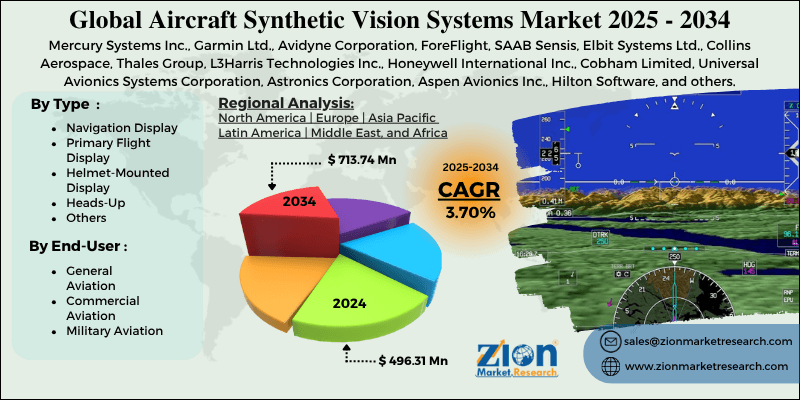
At its core, an aircraft synthetic vision systems market is a computer-generated, 3D representation of the external terrain, obstacles, and flight path on the cockpit’s Primary Flight Display (PFD) or a dedicated screen. It uses a highly detailed global terrain database, enhanced by GPS and inertial reference systems, to create a realistic, “virtual view” of the world outside, regardless of actual weather or light conditions.
Think of it as the aviation equivalent of a night-vision or thermal imaging system, but instead of sensing actual light or heat, it builds the world from stored data. Key features include:
-
Terrain Rendering: Color-coded mountains, valleys, and obstacles (typically amber/red for warnings).
-
Highway-in-the-Sky (HITS): A pictorial tunnel or series of boxes that guides the pilot along the intended flight path.
-
Flight Path Vector: A predictive display showing where the aircraft will be in the next few seconds.
Market Drivers: Why SVS Demand is Climbing
-
The Imperative for Safety: The leading driver. SVS directly addresses Controlled Flight Into Terrain (CFIT), a historical leading cause of aviation fatalities. By providing intuitive situational awareness, SVS gives pilots a crucial “eyes-out” tool even when “eyes-out” is physically impossible. Regulatory bodies like the FAA and EASA are increasingly recognizing and certifying SVS as a safety-enhancing technology.
-
Operational Efficiency and All-Weather Access: For commercial and business aviation, delays and diversions due to low visibility are costly. SVS, especially when combined with Enhanced Vision Systems (EVS) using infrared sensors, can enable operations in conditions that would otherwise ground flights, improving schedule reliability and asset utilization.
-
The Technological Leap in Avionics: The evolution from analog gauges to digital glass cockpits (like Garmin G3000/G5000, Collins Pro Line Fusion, Honeywell Primus Epic) has created the perfect platform for integrating high-resolution SVS. The cost of processing power and high-definition displays has decreased, making the technology viable for a broader range of aircraft.
-
Expansion into New Segments: While initially prevalent in high-end business jets and military aircraft, SVS is now a key selling point for the retrofit and upgrade market for older aircraft, as well as for new Very Light Jets (VLJs) and advanced turboprops. The emerging Urban Air Mobility (UAM) and eVTOL sector is also looking at SVS as a critical technology for navigating complex urban environments.
-
Pilot Workforce Dynamics: As the industry faces experience gaps, intuitive technologies like SVS serve as a force multiplier, helping less experienced pilots maintain superior situational awareness, effectively flattening the learning curve in challenging environments.
Market Segmentation and Key Players
The SVS market can be segmented by:
-
Aircraft Type: Commercial Aviation, Business & General Aviation, Military Aviation, Helicopters.
-
Component: Sensors (GPS, IRS), Displays (PFD, MFD), Computer/Processor, Terrain Database.
-
Fit: Line-fit (new aircraft) vs. Retrofit (existing aircraft).
Dominant players shaping the market include:
-
Garmin Ltd.: A leader in the general and business aviation segment with its widely adopted Garmin SVT™ (Synthetic Vision Technology).
-
Collins Aerospace (RTX): Offers advanced SVS solutions integrated into its Pro Line and Fusion suites for business and commercial platforms.
-
Honeywell International Inc.: Provides its Synthetic Vision Guidance System (SVGS) for a range of aircraft, focusing on integration with its Primus Epic and other avionics suites.
-
Universal Avionics (a subsidiary of Elbit Systems): Known for its retrofittable Vision-1® Synthetic Vision System.
-
L3Harris Technologies, Inc.: Provides advanced display systems with SVS for military and commercial applications.
Challenges and Restraints
Despite the promise, the market faces headwinds:
-
High Initial Cost: Full integration, especially for retrofit, can be expensive, impacting adoption in cost-sensitive segments like general aviation.
-
Regulatory Hurdles: While progressing, certification for use in lower visibility landing minima (e.g., CAT II/III) is complex and requires rigorous validation of database integrity.
-
Database Integrity and Updates: The system is only as good as its terrain and obstacle database. Ensuring global, real-time accuracy and reliable update cycles is a critical, ongoing challenge.
-
Over-reliance Risk: There is a concern that pilots could become overly dependent on the synthetic view, necessitating robust training on its limitations.
Future Outlook: The Path to Integrated Vision
The future of SVS lies not in standalone systems, but in fusion. The next evolutionary step is the Combined Vision System (CVS), which merges the database-driven certainty of SVS with the real-time sensor input of an Enhanced Vision System (EVS). This “best of both worlds” approach provides an unparalleled, reliable view of the runway environment with painted markings, lights, and other live details overlaid on the synthetic world.
Furthermore, integration with Artificial Intelligence (AI) and Augmented Reality (AR) will pave the way for predictive hazard awareness and even more intuitive guidance cues.
Read More-
https://www.zionmarketresearch.com/de/report/pumpkin-seed-oil-market
https://www.zionmarketresearch.com/de/report/cbd-infused-beverages-market
https://www.zionmarketresearch.com/de/report/permanent-magnet-motor-market
https://www.zionmarketresearch.com/de/report/aircraft-weapons-market
https://www.zionmarketresearch.com/de/report/thermal-power-plant-market
Conclusion
The Aircraft Synthetic Vision Systems market is more than a niche avionics trend; it is a fundamental shift in the human-machine interface in the cockpit. Driven by the timeless pursuit of safety and enabled by digital innovation, SVS is moving from a “nice-to-have” feature to a “must-have” standard for modern aircraft. As the technology becomes more affordable and regulations evolve to embrace its capabilities, we can expect to see SVS become ubiquitous, ultimately making the skies safer and more accessible for all classes of flight.
